Augustus Caesar Bust - Item #86
16.5 Inches High x 9.5 Inches Wide x 10.5 Inches Deep
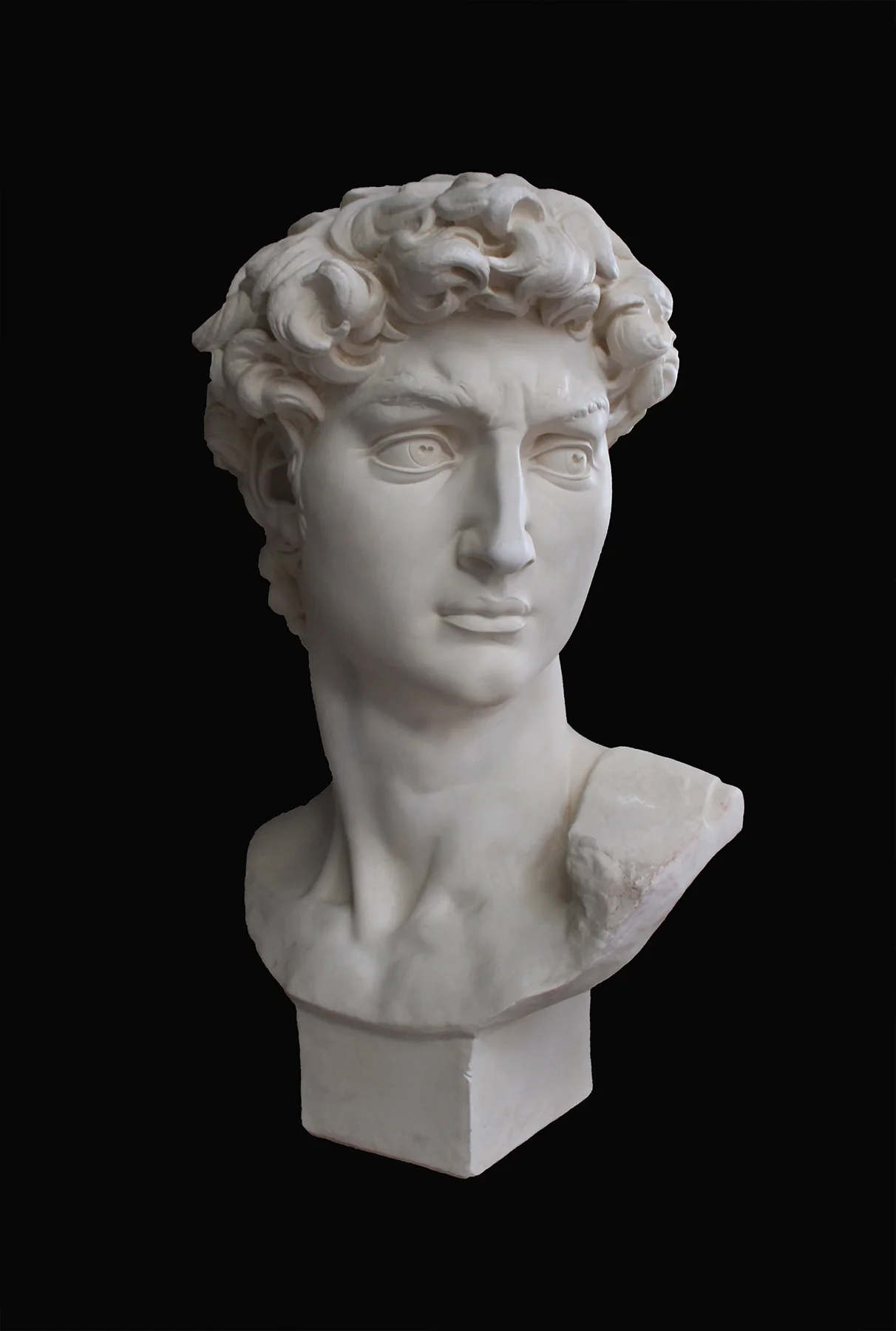
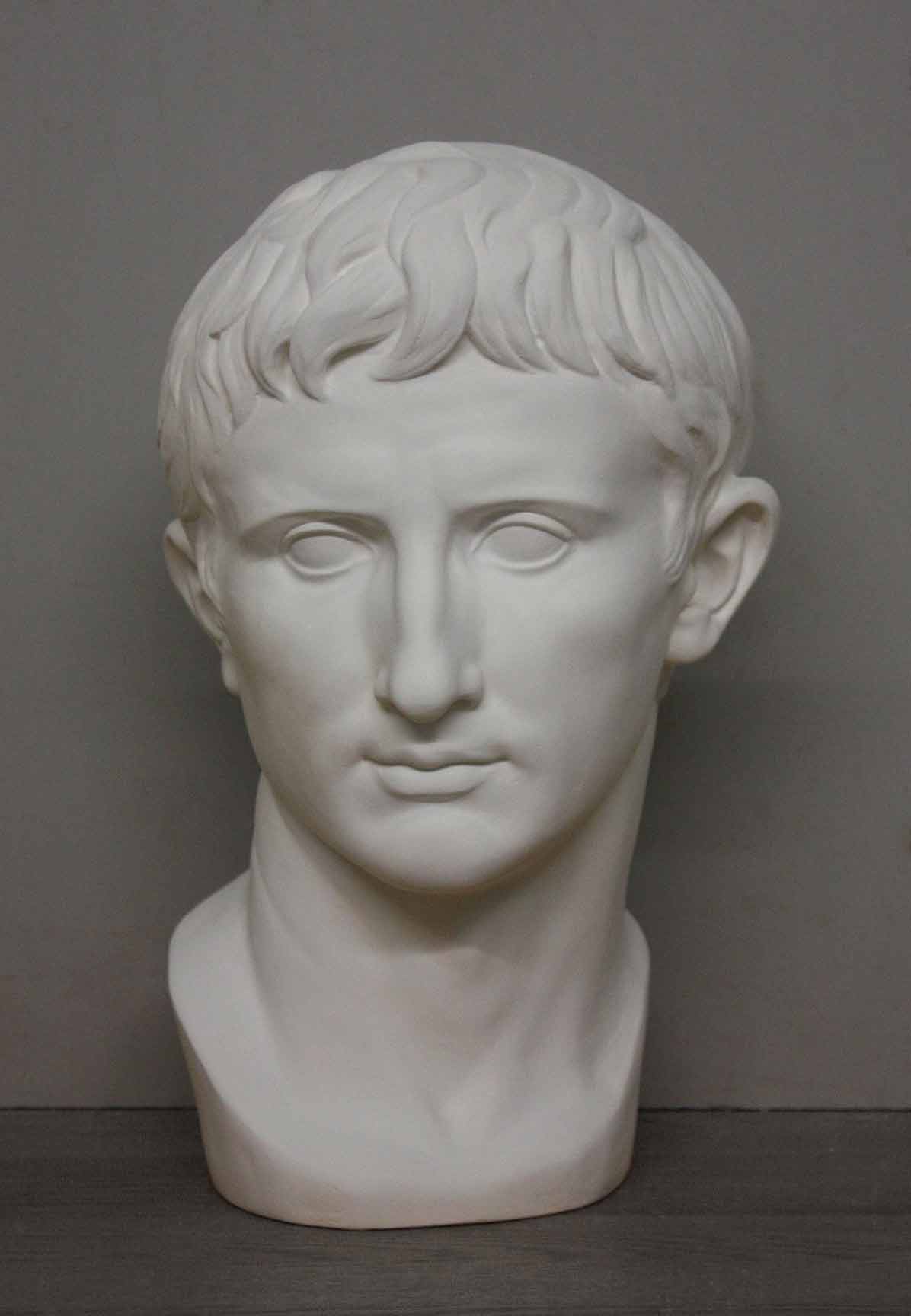
Bust from Item #400, the statue of Augustus Caesar. Augustus's features are idealized here as he desired for his portraits. No matter his age, the Roman emperor who ruled from 27 B.C.E. to 14 C.E. would direct that a new portrait depict him as a handsome, young man. Even after his death sculptors continued to show him in the way he desired, as was the case with this statue. Here he is shown in the Greek classic style of the 5th and 4th centuries B.C.E. with simplified features, a straight line from forehead to nose, and overlapping locks of hair. The original marble statue is likely a copy of an earlier bronze statue, and the marble would have been painted; remnants of many colors have been found. The statue was discovered in 1863 in Prima Porta outside of Rome in the villa where Augustus's wife lived after he died. Comparisons have been made between the sculpture and a type of Greek figurative sculpture, an example of which is the Doryphoros now located in the Naples National Archaeological Museum. The two statues are similar in stance and in classical features.
Artist: Unknown
Museum: Vatican Museums, Vatican City
Origin: Villa of Livia at Prima Porta
Time Period: Ancient Roman- Early 1st century C.E.
Sources:
"Augustus from Prima Porta." Musei Vaticani, http://www.museivaticani.va/content/museivaticani/en/collezioni/musei/braccio-nuovo/Augusto-di-Prima-Porta.html.
Collins, Neil. "Early Classical Greek Sculpture." Art Encyclopedia. Visual-arts-cork.com, 2021, http://www.visual-arts-cork.com/antiquity/greek-sculpture-early-classical-period.htm.
Pollini, John. "The Augustus from Prima Porta and the Transformation of the Polykleitan Heroic Ideal: The Rhetoric of Art." Polykleitos, the Doryphoros, and Tradition, edited by Warren G. Moon, The University of Wisconsin Press, 1995, pp. 262-282. Google Books, https://books.google.com/books?id=gSS7zAfRQQkC&printsec=frontcover&source=gbs_ge_summary_r&cad=0#v=onepage&q&f=false.
Ramage, Nancy H. and Andrew Ramage. "Augustus and the Imperial Idea, 27 BC-AD 14." Roman Art: Romulus to Constantine. 5th ed., Pearson Prentice Hall, 2009, pp. 111-143.
16.5 Inches High x 9.5 Inches Wide x 10.5 Inches Deep
Bust from Item #400, the statue of Augustus Caesar. Augustus's features are idealized here as he desired for his portraits. No matter his age, the Roman emperor who ruled from 27 B.C.E. to 14 C.E. would direct that a new portrait depict him as a handsome, young man. Even after his death sculptors continued to show him in the way he desired, as was the case with this statue. Here he is shown in the Greek classic style of the 5th and 4th centuries B.C.E. with simplified features, a straight line from forehead to nose, and overlapping locks of hair. The original marble statue is likely a copy of an earlier bronze statue, and the marble would have been painted; remnants of many colors have been found. The statue was discovered in 1863 in Prima Porta outside of Rome in the villa where Augustus's wife lived after he died. Comparisons have been made between the sculpture and a type of Greek figurative sculpture, an example of which is the Doryphoros now located in the Naples National Archaeological Museum. The two statues are similar in stance and in classical features.
Artist: Unknown
Museum: Vatican Museums, Vatican City
Origin: Villa of Livia at Prima Porta
Time Period: Ancient Roman- Early 1st century C.E.
Sources:
"Augustus from Prima Porta." Musei Vaticani, http://www.museivaticani.va/content/museivaticani/en/collezioni/musei/braccio-nuovo/Augusto-di-Prima-Porta.html.
Collins, Neil. "Early Classical Greek Sculpture." Art Encyclopedia. Visual-arts-cork.com, 2021, http://www.visual-arts-cork.com/antiquity/greek-sculpture-early-classical-period.htm.
Pollini, John. "The Augustus from Prima Porta and the Transformation of the Polykleitan Heroic Ideal: The Rhetoric of Art." Polykleitos, the Doryphoros, and Tradition, edited by Warren G. Moon, The University of Wisconsin Press, 1995, pp. 262-282. Google Books, https://books.google.com/books?id=gSS7zAfRQQkC&printsec=frontcover&source=gbs_ge_summary_r&cad=0#v=onepage&q&f=false.
Ramage, Nancy H. and Andrew Ramage. "Augustus and the Imperial Idea, 27 BC-AD 14." Roman Art: Romulus to Constantine. 5th ed., Pearson Prentice Hall, 2009, pp. 111-143.
Original: $480.00
-65%$480.00
$168.00Description
16.5 Inches High x 9.5 Inches Wide x 10.5 Inches Deep
Bust from Item #400, the statue of Augustus Caesar. Augustus's features are idealized here as he desired for his portraits. No matter his age, the Roman emperor who ruled from 27 B.C.E. to 14 C.E. would direct that a new portrait depict him as a handsome, young man. Even after his death sculptors continued to show him in the way he desired, as was the case with this statue. Here he is shown in the Greek classic style of the 5th and 4th centuries B.C.E. with simplified features, a straight line from forehead to nose, and overlapping locks of hair. The original marble statue is likely a copy of an earlier bronze statue, and the marble would have been painted; remnants of many colors have been found. The statue was discovered in 1863 in Prima Porta outside of Rome in the villa where Augustus's wife lived after he died. Comparisons have been made between the sculpture and a type of Greek figurative sculpture, an example of which is the Doryphoros now located in the Naples National Archaeological Museum. The two statues are similar in stance and in classical features.
Artist: Unknown
Museum: Vatican Museums, Vatican City
Origin: Villa of Livia at Prima Porta
Time Period: Ancient Roman- Early 1st century C.E.
Sources:
"Augustus from Prima Porta." Musei Vaticani, http://www.museivaticani.va/content/museivaticani/en/collezioni/musei/braccio-nuovo/Augusto-di-Prima-Porta.html.
Collins, Neil. "Early Classical Greek Sculpture." Art Encyclopedia. Visual-arts-cork.com, 2021, http://www.visual-arts-cork.com/antiquity/greek-sculpture-early-classical-period.htm.
Pollini, John. "The Augustus from Prima Porta and the Transformation of the Polykleitan Heroic Ideal: The Rhetoric of Art." Polykleitos, the Doryphoros, and Tradition, edited by Warren G. Moon, The University of Wisconsin Press, 1995, pp. 262-282. Google Books, https://books.google.com/books?id=gSS7zAfRQQkC&printsec=frontcover&source=gbs_ge_summary_r&cad=0#v=onepage&q&f=false.
Ramage, Nancy H. and Andrew Ramage. "Augustus and the Imperial Idea, 27 BC-AD 14." Roman Art: Romulus to Constantine. 5th ed., Pearson Prentice Hall, 2009, pp. 111-143.